

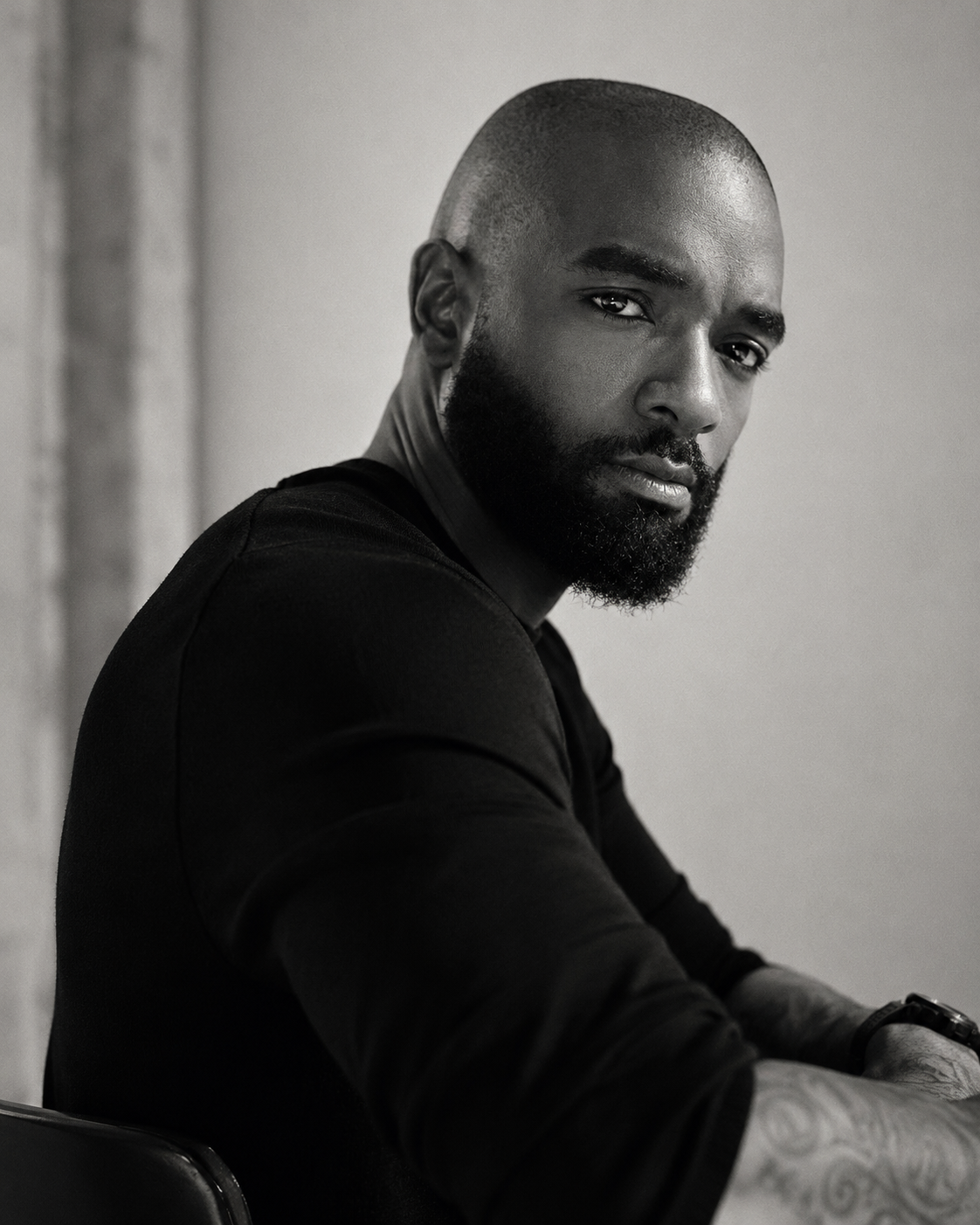
"I've stopped designing for the front. I'm designing for the foundation."
The founder of A-COLD-WALL* and SR_A on selling his stake, his stewardship of the London Design Biennale, and why British design needs to get political again.
Samuel Ross is sitting in his studio in Northamptonshire, the door open, the dog somewhere off-camera. He has — by his count — about ten things on his desk and three more in his head, and we are sitting down to talk about most of them.
The simple version of his last two years is this: in early 2023, Ross sold his remaining stake in A-COLD-WALL*, the streetwear label he founded in his bedroom in 2014 and grew into a sixteen-million-pound business with three British Fashion Awards on the shelf. He kept his industrial design practice, SR_A, and his fine art practice, which has had solo shows at White Cube in London and Friedman Benda in New York. In 2023 he was made an MBE for services to fashion. In 2024 the London Design Biennale named him artistic director of its fifth edition, which opened at Somerset House in June 2025 under the theme Surface Reflections. He turned 34 the day before the opening.
"My twenties were about proving the thing was possible," he says. "My thirties are about the question of what design is actually for. They're different questions. They require different muscles."
The conversation keeps returning to a word he uses with unusual frequency: stewardship. He sees himself, increasingly, as a custodian — of British design, of the next generation of Black British artists (through the grants programme he set up in 2020, which has now funded fifty artists), of a particular kind of intellectual seriousness he feels has gone missing.
"My honest critique of British design right now is that it's sustaining mediocrity. There's a comfort with style over substance. People are designing for the front of the magazine and not for the foundation of the practice. I think we've forgotten that design is political. Every chair is a class statement. Every garment is a class statement. We've trained ourselves to pretend that's not true."
The Biennale, he says, was an opportunity to argue otherwise. Surface Reflections invited more than forty national pavilions to reflect on identity, history, and inheritance — what Ross described, in his own opening text, as "the multifaceted hues of human experience." It was, by all accounts, the most ambitious edition the event has staged.
"I wanted the room to feel hyper-local and hyper-global at the same time. Design as the equaliser. Each pavilion says: this is who we are, on our terms. London, for one month, was the meeting place."
His own practice is shifting. SR_A is now the centre of his commercial output — design work with LVMH, Apple, Nike, Kohler, and a long-running collaboration with the watchmaker Hublot — and he speaks about it the way a sculptor speaks about a foundry. "The objects we're producing now are heavier. Stone, metal, hardwood. They're meant to outlive the trend cycle. That's the point."
In 2024 he launched SR_A SR_A — Studio Research_Attire — a quieter, slower wearable luxury line of handmade garments produced by British and European small-scale manufacturers. He describes it almost as a relief. "After ten years of the streetwear pace, I wanted to make clothes that aren't trying to win the week. They're trying to be worn for thirty years."
He talks about his daughters — Genesis and Olympia — with the same structural seriousness he brings to everything else. "I've taken care of my family. That's done. So now the next question is: what do I owe back? I think about that constantly. The grants programme is part of it. The Biennale was part of it. But there's a bigger version of that question that I'm still working out."
Where is the bigger version going? He has said publicly that he is interested in architecture, in education, in policy. He doesn't commit, today, to any of it.
"I think there's a version of the next decade where I move further away from product and closer to systems. Designing the conditions under which other people make things. That's interesting to me. Whether that's a foundation, a school, a department inside an institution — I don't know yet. But the product output of SR_A is, I think, going to slow down on purpose. I'm not going to flood the market. I never wanted everyone wearing my t-shirt. I wanted the right person, wearing the right object, in the right room."
He smiles. "Maybe that's snobbery. I'd call it discernment."