

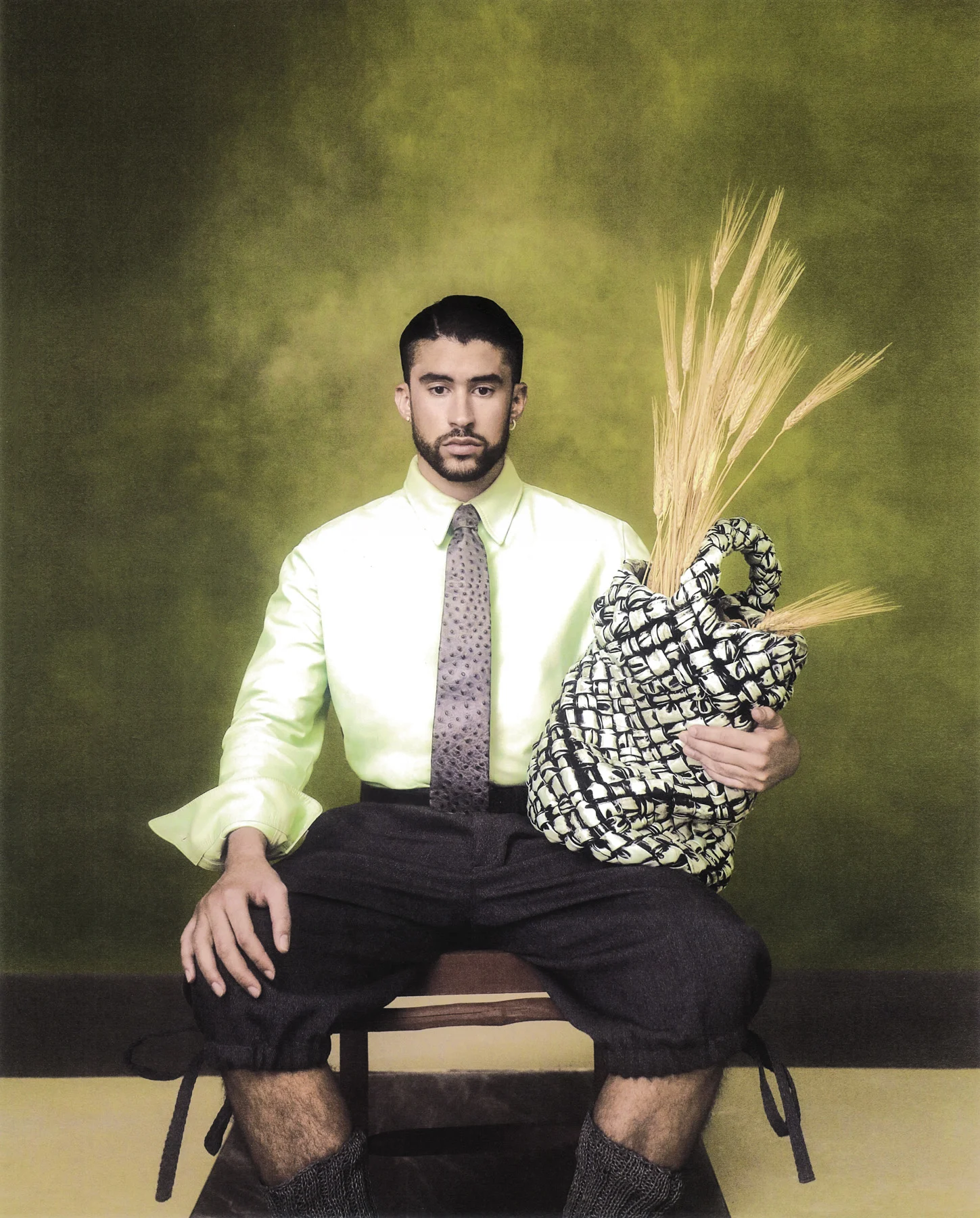
"I make pictures the way other people make scenery for a play."
The Hungarian, Milan-based photographer behind the year's most-talked-about portraits — Willem Dafoe, Rama Duwaji, Elle Fanning — on natural light, painted backdrops, and the slow art he refuses to give up.
Szilveszter Makó answers from his studio in Milan, where it is mid-afternoon and the light, he tells me with quiet satisfaction, is "very good today, very flat." He is dressed in something soft. There is a piece of painted cardboard behind him that I assume is a wall and then realise, halfway through the conversation, is a prop from a shoot he finished last week.
His work over the last two years has become something close to ubiquitous in the kind of magazines that still care about pictures. Willem Dafoe's head emerging from a wooden house for GQ Italia. Elle Fanning brandishing a giant flaming fork. Cate Blanchett pressed into a geometric box. And, most recently, a now-famous editorial for The Cut of Rama Duwaji — the Syrian-American illustrator and the partner of New York's new mayor — in a series of portraits that critics compared to Magritte and to 1940s portrait studios in roughly the same breath.
"I am very flattered when people compare it to painting," he says, slowly. "Because the truth is — I started as a painter. I was not good at it. I am too impatient. So I moved to photography, and what I'm really doing, I think, is using a camera to make paintings."
His process is, by the standards of modern fashion image-making, almost perverse in its slowness. The sets are built by hand — by him, by his assistants, often from recycled materials. The light is, with very few exceptions, natural; he has spoken before about needing windows the way other photographers need expensive strobes. The post-production is something he refuses to fully explain. "I would not call it a secret," he says, with the smallest smile. "More of an unorthodox process. The people who really understand analog photography — they can see what I'm doing. The technique is very old. I just brought it back."
What makes a Makó image identifiable, at this point, is harder to name than the parts. There is the chiaroscuro — the deep shadows, the single warm light source falling across a face. There is the geometry: the recurring use of cubes, houses, boxes, frames within frames, the subject literally architectured into the photograph. And there is a quality the writer Claire Marie Healy once called "absurdist and theatrical" — a slight wrongness that makes you look longer.
"I'm interested in shelter," Makó says. "In enclosure. The Dafoe picture — the house around his head — that came from a memory I have, from childhood, of small wooden houses in the forest in Hungary. I grew up partly in a place called Lillafüred. It's very quiet there. The trees are very close to the buildings. I think a lot of my pictures are still that landscape, even when they're for Vogue."
He is generous about his collaborators. He talks about the stylists who work with him — Jessica Willis on the Duwaji story, a roster of others he names with care. He talks about his assistants. "Every person who cuts the cardboard, every person who mixes a colour — they are making brushstrokes. The picture is never one person. I think this is the part of the work that gets lost in the credits. You see a name under the picture. You don't see the six people who built the room."
He is suspicious of how fast the industry now moves. "The pressure to make pictures for the phone is so big. Everything is vertical, everything is fast, everything is rendered to look the same on the same screen. I'm not against the phone — my mother sends me pictures of her garden every day — but I do not want to make photographs that only live there. I want my pictures to look like they were found in an attic in 1932. I want someone to wonder how old they are."
What is he working on next? He is careful — he doesn't like to announce. He mentions a long-form personal project that involves painted backdrops in the literal style of nineteenth-century travelling photographers' tents. He mentions a book, eventually, with a publisher he won't name. He mentions, almost in passing, that he would like to design for opera. "The set. The costumes. Maybe even direct it. I think about it more and more. The theatricality of my pictures — it wants somewhere bigger to live."
Before he goes, he wants to correct something the press has said about him often. "People say I am nostalgic. I am not nostalgic. Nostalgia is about wanting to return. I am not trying to return anywhere. I am trying to slow the present down until you can see it properly. That is different. That is the whole point of the work."
The light, behind him, has shifted a few degrees warmer. He notices. He smiles. "I should go. The window is at its best now."